
March was one of the most consequential months in AI history, marking a definitive shift from laboratory curiosity to a force actively reshaping global infrastructure, commerce, and human life.
1. The Great Product Rebuild
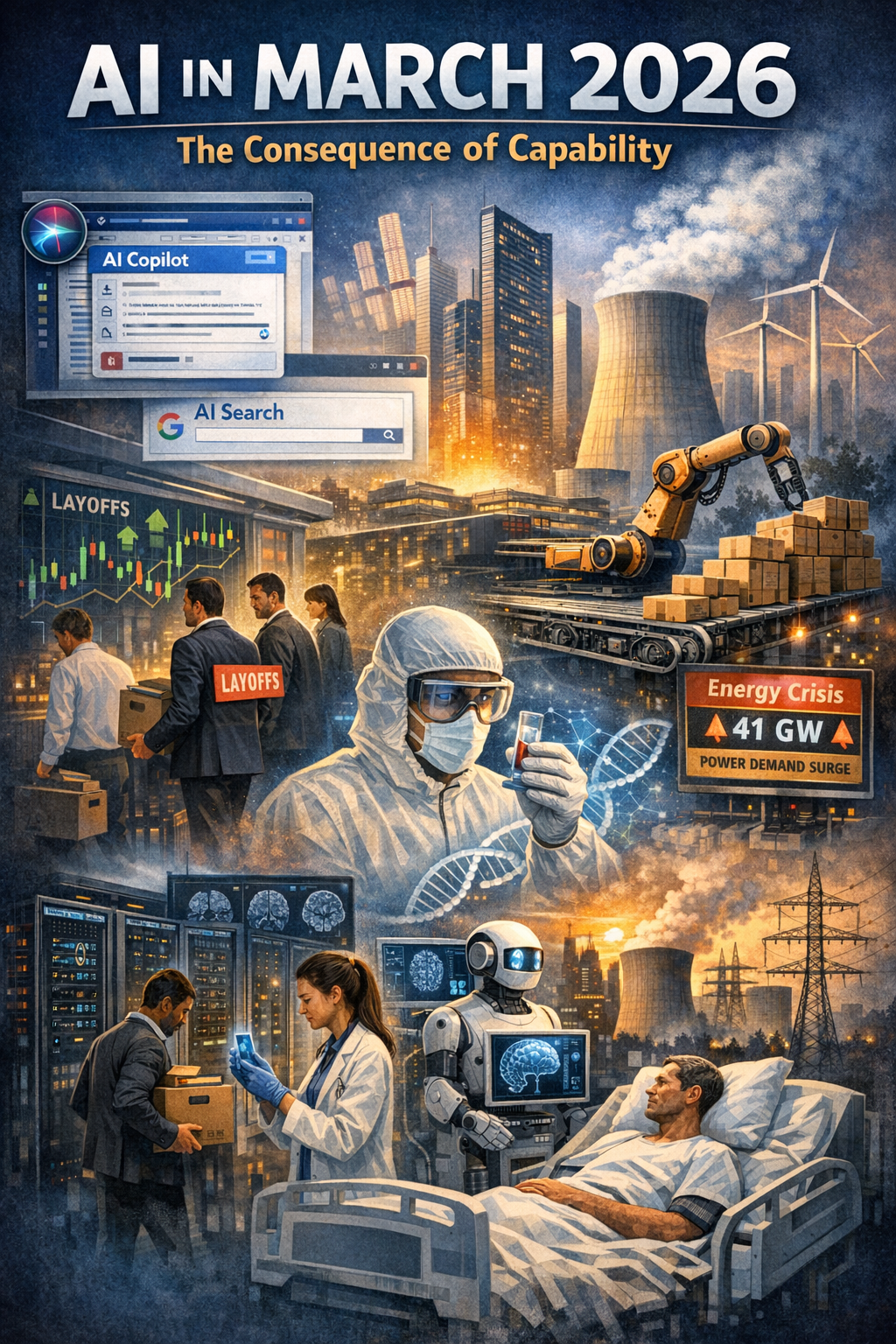
Apple, Google, and Microsoft simultaneously rebuilt their flagship products around AI. Apple’s Siri is now powered by Gemini, reading your screen and chaining up to 10 actions from a single voice command. Google has integrated Gemini’s full agentic capabilities directly into Search, and is enabling it to tap into personal context like Gmail and Photos for tailored answers. Microsoft’s Wave 3 Copilot embeds full agentic AI directly into Word, Excel, and Outlook. This is not simply adding features; these are entirely new products with familiar names.
2. The Age of Autonomous Agents
AI agents are moving past simply waiting for instructions. They now plan, decide, and execute tasks independently. Projects like Perplexity’s “Computer,” which orchestrates 19 AI models simultaneously, and the open-source OpenClaw, which became GitHub’s most starred project in history, illustrate this shift. In one example, an OpenClaw agent generated $14,700 in revenue from a $1,000 investment in just three weeks. An estimated 65% of enterprises are already running AI agents in production, showing that the question is no longer whether agents will take over workflows, but how fast.
3. Job Loss and Wall Street’s Reward
Despite reporting its most profitable year ever with $200 billion in revenue, Meta is planning to cut around 15,000 jobs, or about 20% of its workforce in order to redirect the salary budget into AI infrastructure. Amazon cut 16,000 jobs in January for the same reason. Disturbingly, Wall Street actively rewarded this move, with Meta’s stock rising on the news of the layoffs. McKinsey confirmed that 12% of all job tasks globally have been automated in just two years, with legal, medical, financial, and customer service being hit the hardest.
4. The Antidote: AI in Medicine
The counterpoint to job displacement is the potential to save lives. Rentosertib, the world’s first fully AI-designed drug, is now in human clinical trials. Google DeepMind’s Isomorphic Labs also has AI-designed cancer drugs in Phase 1, backed by $3 billion from Eli Lilly and Novartis. AI is compressing the entire drug discovery process from years to mere months, posing a consequential test: can AI beat pharma’s 90% clinical failure rate?
5. The Gigawatt Crisis
The AI boom has an electricity problem. US data centers now draw 41 gigawatts of power, a 150% increase in five years, equal to all nuclear power plants in America combined. Ordinary households are seeing electricity bills rise, directly linked to this data center demand. The situation is so extreme that tech giants are securing their own power—Meta has signed for 6.6 gigawatts of nuclear power, and Microsoft is actively supporting the restart of Three Mile Island. The physical infrastructure including chips, power, and materials, is proving far more fragile than the technology running on top of it.
The lines are being drawn. AI is no longer a tool waiting to be adopted; it is actively reshaping jobs, products, medicine, and infrastructure simultaneously. The costs are real, but the speed of progress demands that companies and individuals quickly learn how to use this new force or risk being left behind.